Recent News

By Tag

See all

By Month

See all

Advanced Energy Gains 125,000 Jobs in 2018, Growing Twice as Fast as U.S. Employment Overall

Posted by Bob Keough on Mar 20, 2019


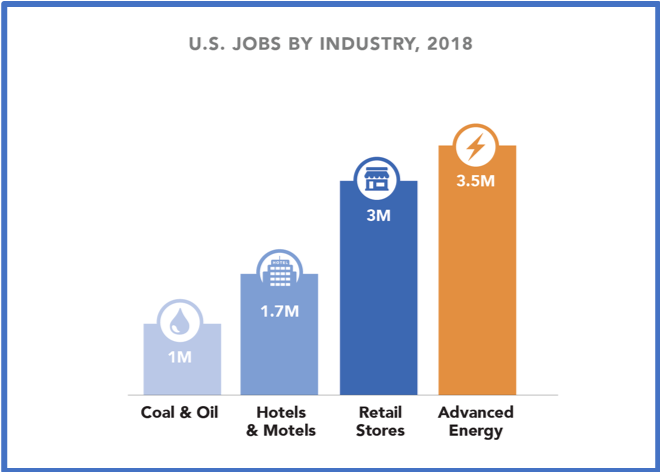
With 3.5 million jobs, advanced energy industry employs more U.S. workers than retail stores, twice as many as hotels and motels, three times coal and oil industries

WASHINGTON, D.C., March 20, 2019 – Today national business group Advanced Energy Economy released a fact sheet showing that the advanced energy industry employed 3.5 million U.S. workers in 2018, an increase of 125,000 jobs over 2017. Advanced energy employment grew 4 percent year-over-year, more than twice as fast as the overall U.S. employment growth rate of 1.5 percent. Employers expect to add 6 percent more advanced energy jobs in the coming year.

Read More

Topics: Press Releases

Washington Examiner: Big problem facing the Green New Deal: A lack of power lines to deliver wind and solar

Posted by Josh Siegel on Mar 20, 2019

This piece by the Washington Examiner discusses how the Green New Deal is all but impractical without addressing how critical transmission lines are to its implementation. The AEE perspective is given by Managing Director and General Counsel Jeff Dennis. See excerpts below and the entire Washington Examiner story here:

Read More

Topics: United In The News

Windpower Engineering: Nevada to join U.S. Climate Alliance

Posted by Michelle Froese on Mar 12, 2019

This Windpower Engineering & Development piece covers Nevada Governor Steve Sisolak’s decision to join a growing number of states in entering into the U.S. Climate Alliance, quoting AEE's Ray Fakhoury. See excerpts below and the entire Windpower Engineering story here

Nevada Governor Steve Sisolak announced that the state would join the U.S. Climate Alliance, a coalition of state governors pledging to reduce carbon emissions and support clean, renewable energy growth throughout the country.

Read More

Topics: United In The News

Utility Dive (Opinion): BQDM Program Demonstrates Benefits of Non-traditional Utility Investments

Posted by Coley Girouard on Mar 11, 2019

Utility Dive ran AEE's third case study in a six-part series on utility business reform.This one covers how the Brooklyn-Queens demand management (BQDM) program demonstrates the clear benefits (and some challenges) of non-traditional utility investments. See excerpts below and the complete Utility Dive piece here. Access the foundational report and five case studies series here that AEE produced with RMI and APP.
 
Read More

Topics: United In The News

Governing: The Green New Deal? It's Already Happening in Our Communities

Posted by By Steven Pedigo and Abigail Sindzinski on Mar 11, 2019

Governing Magazine covers how cities large and small (and several states) are stepping up their efforts to combat climate change and cope with its impact. The authors cite the economic benefits of the advanced energy economy, specifically referencing AEE's half million jobs figure for California as a tangible example. See the entire Governing article here.

Many critics have portrayed the Green New Deal, with all its hope for our climate policy, as radical. To be sure, the proposal by congressional progressives to meet all energy demand from zero-emissions sources in 10 years is highly ambitious. But for cities -- places where the effects of climate change are especially pronounced and a growing share of the population lives -- the radical way forward is inaction. Cities need to be formulating their own plans to combat climate change and to blunt its impact through resilience planning...

With the current political climate, local governments can be effective and nimble at getting more done. Cities are major contributors to greenhouse gas emissions (responsible for 70 percent of carbon dioxide emissions worldwide, according to the C40 Cities Climate Leadership Group). Many local governments are already stepping up, implementing climate strategies and benchmarks that reflect the goals of the Green New Deal. And in some cases, local governments' efforts are being bolstered or led by those of forward-looking state policymakers...

California and its cities are on the clean-energy forefront [and...] The economic benefits of the advanced energy economy in California have been tangible, with more than half a million jobs in the clean energy sector as of April 2017... [the article shares examples of several other states from N.J. to Minn.]

As these efforts illustrate, there is much that cities and states can do -- and in many cases are already doing -- to combat climate change. Key areas for action include not only energy generation and consumption but also transportation, waste management and the built environment...

Read the entire 
Governing article here.

Read More

Utility Dive: Consumers Shouldn't Pay for Bureaucratic Thinking on Electricity

Posted by Devin Hartman and Caitlin Marquis on Mar 8, 2019

Utility Dive published this commentary by AEE Director Caitlin Marquis and Electricity Consumers Resource Council President and CEO Devin Hartman on a consumer-focused approach to reliability and resilience in energy policy, based on the evolving characteristics of the power industry. See the entire Utility Dive article here

The past two years of federal energy policy debates have focused on two key related areas: reliability and resilience. For more years than that, public debate has centered on the potential challenges associated with the retirement of traditional grid resources like coal and nuclear plants. Throughout all of this, the consumer voice has largely been ignored, instead overruled by incumbent electricity generators and political interests.

Read More

Topics: United In The News

Yale Climate Connections: Is the Grid Ready for Electric Vehicles?

Posted by Jan Ellen Spiegel on Mar 5, 2019

This Yale Climate Connections post looks at how the grid can best prepare to integrate electric vehicles (EVs)), with perspective by AEE's Matt Stanberry, See excerpts below and read the entire Yale Climate Connection story here, which includes an excellent summary of Con Edison's EV pilot programs.

Some Americans appear increasingly ready to give up their gas cars for electric vehicles. But are the country’s electric grids prepared for them?

The question is a critical one in the quest to address climate change, because transportation is now the single largest sector contributing to U.S. greenhouse gas emissions. EVs are widely viewed as a key way to help change that.

Read More

Topics: United In The News

Forbes: Maximizing Distributed Energy Resources: Global Insights on... Grid Regs

Posted by Mike O'Boyle on Mar 5, 2019

Forbes featured AEE’s graphic of Performance-Based Regulation by state in this story about new research on how various governments are exploring the best policies to effectively deploy more distributed energy resources. See excerpts below and read the entire Forbes piece here:

Read More

Topics: United In The News

CleanTechnica: Electric Vehicles Can Lower Electricity Prices

Posted by Charles Morris on Feb 27, 2019

This CleanTechnica post discusses how EV ownership can benefit electric ratepayers just as much, if not more, than their owners. The article references AEE’s webinar EVs 101: What Regulators Need to Know About Electric Vehicles, which featured a panel of experts including Proterra’s Eric McCarthy, Siemens' Chris King, and AEE's Matt Stanberry. See excerpts below and read the entire CleanTechnica story here:

Regular readers of this column are well aware of the wonderful benefits of EV ownership. However, electric vehicles can also have a positive impact on the electric grid, serving as the perfect complement to renewable energy sources. Jeff McMahon, writing in Forbes, notes that a growing body of evidence supports the idea that the spread of EVs is good news for electric ratepayers.

Read More

Topics: United In The News

Washington Post (AP): Walmart stuck with Dominion, setting up potential fight

Posted by Alan Suderman on Feb 26, 2019

This story by Alan Suderman of the Associated Press and published by the Washington Post covers the aftermath of Virginia regulators’ decision to deny Walmart the option of buying electricity from a provider other than Virginia’s two utilities, Dominion Energy and Appalachian Power. The AEE perspective is given by Harry Godfrey, executive director of Virginia Advanced Energy Economy. See excerpts below and read the entire Washington Post (AP) story here:

Virginia regulators have denied Walmart’s request to buy electricity generated by someone other than the state’s two largest electric monopolies, setting up a potential legislative brawl between heavyweight business interests.

Read More

Topics: United In The News