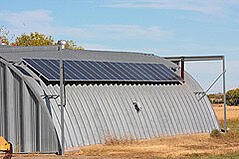
 Third party financing of solar energy has become a hot commodity around the country. Historically, individuals or businesses that wanted solar power had to pay for the system up front and then realize the savings over time. Essentially, the first kWh cost $16,000 or more, but then the electricity is free as long as the panels last. Solar owners who bought systems this way always got the question, “how long does it take that system to payoff?” (Funny, I’m not aware of any electric utility saying the bill they send you is going down because they’ve “paid off” their power plants, but I digress.)
Topics: State Policy
The U.S. Environmental Protection Agency’s (EPA’s) plan to regulate carbon emissions is just the latest challenge facing the U.S. electric power system. Technological innovation is disrupting old ways of doing business and accelerating grid modernization. Earlier this year, AEE released Advanced Energy Technologies for Greenhouse Gas Reduction, a report detailing the use, application, and benefits of 40 specific advanced energy technologies and services. This post is one in a series drawn from the technology profiles within that report.
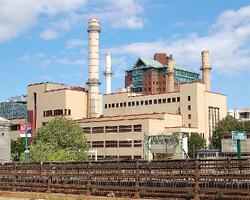 Industrial Combined Heat and Power (CHP, also called cogeneration) uses a single fuel, often natural gas, to co-produce electricity and heat for use in industrial operations, usually on site. Industrial CHP accounts for more than 75 GW out of the approximately 82 GW of installed CHP in the United States, or 7% of the country’s total generation capacity. CHP can be applied widely within the industrial sector, but is particularly well suited for industries with significant, steady thermal loads such as refining, chemicals, pharmaceuticals, and forest products.
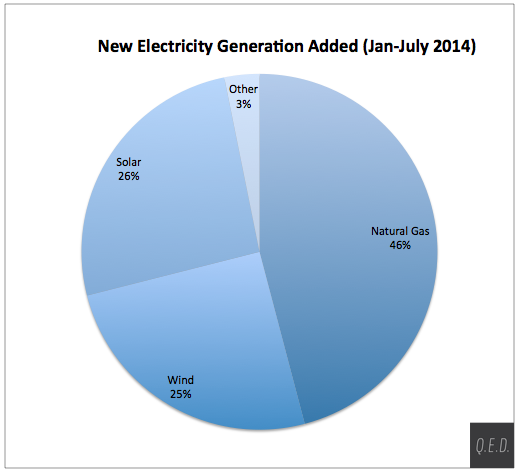
Advanced energy is on the march. A new report from the Federal Energy Regulatory Commission (FERC) shows that, of all the new electric generating capacity installed in the U.S. since January, more than 97 percent was advanced energy: 46 percent natural gas, 26 percent solar, and 25 percent wind. The remaining 3 percent of new capacity shown as “other” in the accompanying chart includes 87 megawatts of biomass, 32 MW of geothermal steam, and 19 MW of hydro. That means, in fact, that 99.7 percent of the 4,758 MW of new generating capacity added in the first seven months of the year was advanced energy – 11 MW of oil-fired generation and 1 MW of truly “other” accounted for the remainder. In July, all the new capacity that month came from wind (379 MW) and solar (21 MW). The FERC numbers count only utility-scale installations, and do not include solar installed on residential and commercial rooftops.
Topics: News Update
 The past couple weeks brought two federal regulatory victories for the advanced energy industry. First, on August 8, the Internal Revenue Service released new guidelines that will make it easier for projects to qualify for the renewable energy production tax credit (PTC), which is critical for the wind power industry and other renewable technologies. Then, on August 15, a federal appeals court unanimously affirmed the Federal Energy Regulatory Commission’s (FERC) Order 1000, which will change the way regional transmission projects move forward and ultimately lead to more advanced energy on the grid.
Topics: Federal Priorities
The U.S. Environmental Protection Agency’s (EPA’s) plan to regulate carbon emissions is just the latest challenge facing the U.S. electric power system. Technological innovation is disrupting old ways of doing business and accelerating grid modernization. Earlier this year, AEE released Advanced Energy Technologies for Greenhouse Gas Reduction, a report detailing the use, application, and benefits of 40 specific advanced energy technologies and services. This post is one in a seriesdrawn from the technology profiles within that report.
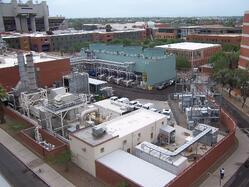 Combined Heat and Power (CHP), also called cogeneration, generates both electricity and useful heat from the same fuel source. CHP typically involves dedicated equipment to generate electricity, followed by recovery of exhaust/waste heat for use in industrial processes, space heating, or water heating. Any fuel can be used for CHP, including fossil fuels and renewable fuels. In certain industries, onsite “waste” fuels are used for CHP, such as wood chips, bark and sawdust in forest products, blast furnace gases in steel mills, and various process gas streams in refining and petrochemicals. Because thermal energy (steam, hot water) is more difficult to transport than electricity, CHP systems are typically installed at or near a suitable thermal load. Most U.S. CHP capacity is installed at industrial sites, but it is also fairly common at college campuses, hospitals, military bases, and in district energy plants.[1] Housing complexes and commercial buildings also use CHP. So-called micro-CHP can be used in residences and small commercial buildings for water or space heating or for heating swimming pools. CCHP (combined cooling, heating, and power) is a variation of CHP that uses the waste heat to drive a cooling system (via an absorption chiller) in addition to generating heat and power. CCHP can make sense when heating loads are more seasonal and where there are large cooling requirements, resulting in higher overall utilization of waste heat than would be possible just with CHP.