This post is one in a series featuring the complete slate of advanced energy technologies outlined in the report This Is Advanced Energy.
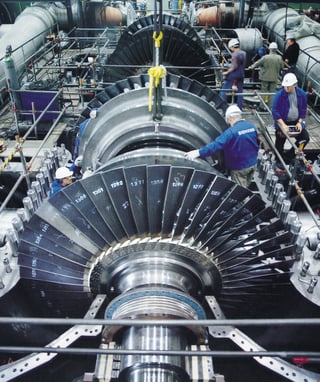
Gas turbine technology is mature and widely used, with innovations driving new improvements in efficiency, performance, and cost. In its most basic configuration, the simple cycle gas turbine (SCGT), air is compressed and mixed with fuel (usually natural gas), then the mixture is burned in a combustor. The resulting hot, pressurized gases expand through the turbine section that drives the compressor and an electric generator. In a combined cycle gas turbine (CCGT) plant, also called a natural gas combined cycle (NGCC) plant, the hot exhaust gases leaving the turbine pass through a heat recovery steam generator, producing steam that is used to generate more electricity with no additional fuel. This process can increase efficiency to 60%, compared to about 40% for SCGTs. Most gas turbine plants in operation use so-called “heavy duty” or “industrial” turbines, with units ranging from about 1 MW to over 300 MW. The other main type of machine, an aeroderivative gas turbine, ranges in size up to about 90 MW. These turbines are more lightweight, compact, and even more efficient. Another class of machines, microturbines, have lower efficiencies than the larger turbines, but are well suited for onsite power and CHP due to their compact footprint and smaller size (25 kW to 500 kW).
 It’s no mystery that companies want advanced energy—they’re announcing major projects, making large purchases, and setting public goals. Even for companies without a specific target, advanced energy presents an attractive option to control and lower energy costs. Unsurprisingly, companies are pursuing advanced energy in growing numbers, with a record 3,100 MW of wind power purchases in 2015 signed by corporate customers—double the previous year.