Pennsylvanians’ electric bills are going up, and electric utilities will be spending more than ever on energy and infrastructure. Utilities’ traditional response to rising demand is to build more power plants and grid infrastructure (poles, wires, substations). However, expanding supply and delivery capacity is only one tool in the toolbox—and it’s not always the fastest, cheapest, or most efficient way to meet system needs.
Fortunately, there is a tool that Pennsylvania has yet to deploy at scale that can offer relief to energy consumers, one that will require legislative action to fully unlock. If state legislators pass policy to enable virtual power plants (VPPs) this year, Pennsylvanians will be able to harness the thousands of energy resources already in their homes and businesses to help control their bills.
As electricity demand rises and grid stress become more frequent and severe, VPPs can respond quickly and cost-effectively by coordinating thousands of already-existing smaller, distributed energy resources (DERs), such as rooftop solar, battery storage, smart thermostats, and other flexible devices such as heat pumps and electric vehicle (EV) chargers, to operate together like a single power plant when the grid needs support most.
By saving or sharing power from these resources at key times—and getting compensated to do so— Pennsylvanians can save money and reduce the need for utilities to buy electricity when it is most expensive, like they do today. These actions can also reduce the need for investing in costly new power plants that may only get used for a handful of hours each year.
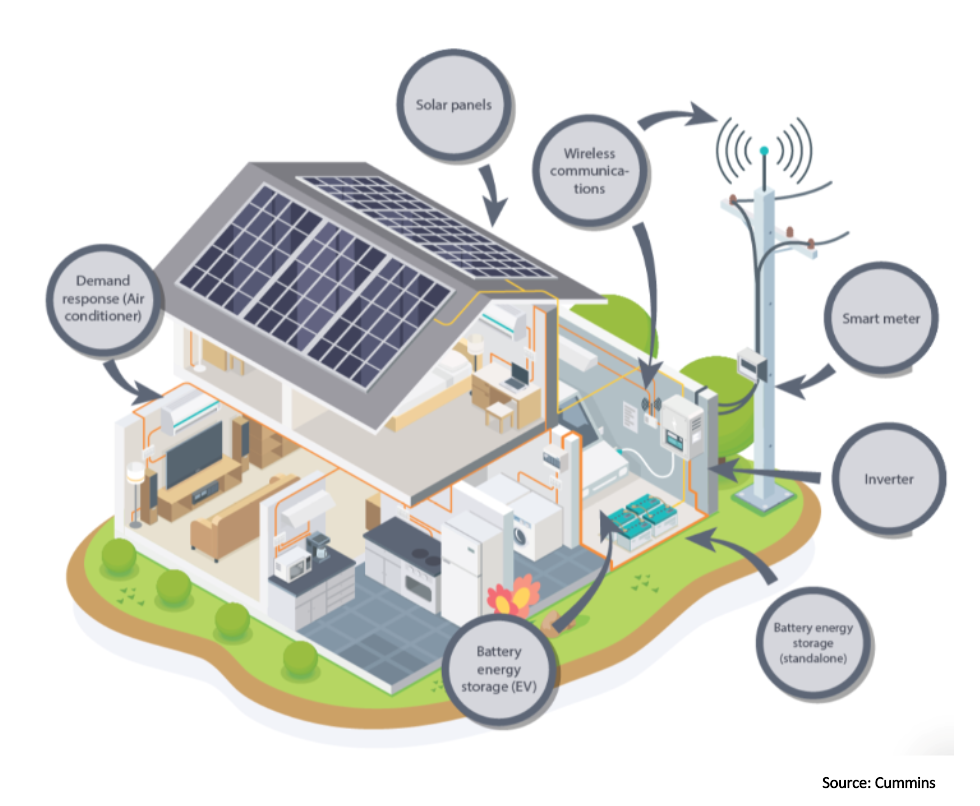
A VPP is an aggregation of DERs located on customer premises + a mechanism for orchestrating electricity demand, generation, and/or storage from DERs using a common architecture. VPPs coordinate many systems that look like the image above.
A useful way to understand VPPs is to think of an orchestra. Each instrument matters on its own, but real power emerges only when they play in sync. An orchestra relies on a conductor to keep everyone aligned, setting the tempo and signaling exactly when to play louder or softer.
In a VPP, DERs are the instruments, and the conductor is a third-party aggregator using software and real-time signals to coordinate them. Ahead of a peak demand event, the aggregator cues participating devices across a utility territory to respond together. At the critical moment, batteries increase their output, while flexible devices like smart thermostats, and EV chargers briefly reduce or shift electricity use to relieve grid strain.
When a period of peak demand occurs, such as a sweltering summer afternoon with air conditioners running full blast, these resources can be called on almost instantly. Individually, the changes are barely noticeable to customers. Collectively, they can provide the same grid support as a conventional power plant, at lower cost and with greater speed.
By harnessing community power in this way, Pennsylvania can meet rising demand more efficiently, improve reliability, and reduce system costs without overbuilding expensive infrastructure. Smarter coordination that leverages DERs will be essential to keeping power affordable and reliable across the Commonwealth.
And just as musicians who choose to join an orchestra are compensated for their performance, customers that opt in to this program would be paid for the flexibility and value they provide to the grid. And all Pennsylvanians—even those who do not have these energy resources in their homes and businesses—will also see savings on their bills as VPPs reduce overall costs for everyone.
As states around the country realize the benefits of this type of program, numbers on its impact have rolled in. Analysis by RMI finds that VPPs could reduce annual U.S. power-sector expenditures by roughly $17 billion by 2030. Deploying up to 60 gigawatts of VPPs nationwide could generate between $15 billion and $35 billion in system-wide savings by avoiding costly peak generation, reducing the need for new transmission and distribution upgrades, and lowering wholesale power prices during the most expensive hours. These savings ultimately flow through to customers in the form of lower bills and improved reliability—demonstrating that VPPs are a proven strategy for controlling costs.
So why aren’t VPPs already widely deployed in the Commonwealth?
One reason is the business model of most utilities incentivizes them to build capital-intensive infrastructure, and VPPs do not fit this category because they require relatively little utility investment. To fully realize their potential, Pennsylvania needs legislation that requires utilities to act.
Representative Nate Davidson has a cosponsorship memo and legislation under consideration that will require utilities to establish programs that harness community energy resources, moving the Commonwealth in the right direction. Similar legislation passed last year in Virginia on a bipartisan basis.
With smart policies, VPPs can play a key role in making energy more affordable and reliable for all Pennsylvanians. As electricity bills rise, Pennsylvania is ready for a new approach to utility spending, and there is no better time to act.